



Workday logo

Unified Cloud HCM With Built-In AI Agents For Large US Employers

Workday HCM brings core HR, payroll, talent, recruiting, learning, and workforce planning onto a single cloud data model, now extended with AI agents for hiring, payroll, and employee self-service. It is used by more than 11,500 organizations, including over 65% of the Fortune 500.
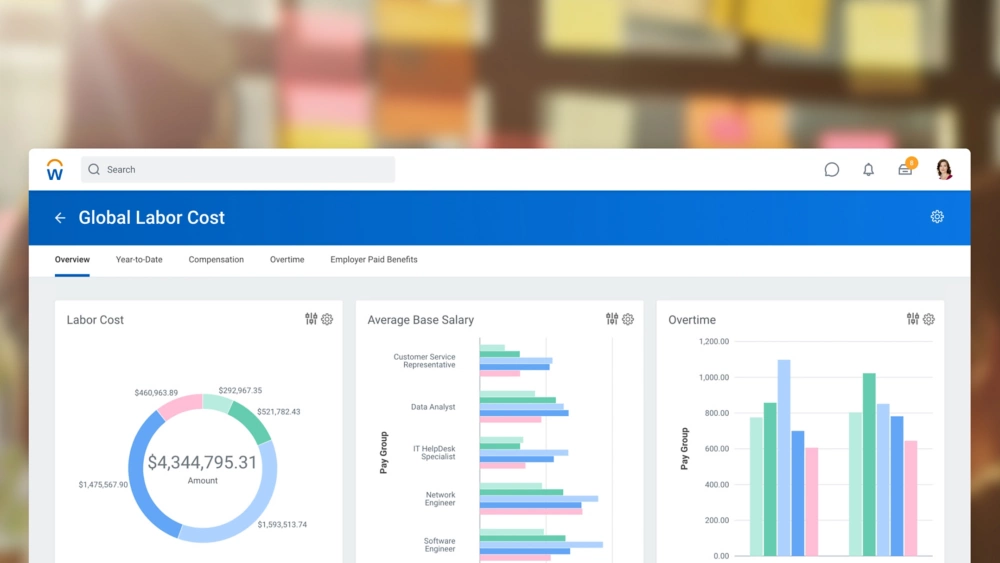
Workday platform dashboard

About Workday

Industry leader in connected fleet operations

Market Position

Named a Leader in Gartner's Magic Quadrant for Cloud HCM Suites for 1,000+ Employee Enterprises for the 11th consecutive year in 2026, and used by over 65% of the Fortune 500.

Innovation Focus

Agentic AI across HR, including the Sana assistant, a Payroll Agent, a Talent Acquisition Agent, and Paradox conversational hiring, with 1.7 billion AI actions processed in fiscal 2026.

Core Strengths

Breadth of functionality on one data model, unified reporting across HR and finance, and deep talent and skills capabilities.

Use Cases

Global core HR and payroll, high-volume and frontline hiring, skills-based talent management, workforce planning, and employee service delivery.

Discover Workday’s Complete Human Capital Management Suite

Core Products & Solutions

Integrated HCM modules and AI agents sharing one employee record
Core HCM

Core HCM

The system of record for workers, organizations, positions, compensation, and benefits, with configurable business processes and employee and manager self-service. It also covers contingent worker management and HR service delivery.

Payroll and Payroll Agent

Payroll and Payroll Agent

Workday Payroll runs natively in the US, UK, Canada, and France, with Global Payroll Cloud connecting partner providers elsewhere. An AI Payroll Agent assists with pay audits and answers complex payroll questions.

Talent Management, Learning and Skills Cloud

Talent Management, Learning and Skills Cloud

Performance, goals, succession, career development, and Workday Learning are tied to Skills Cloud, which maps worker skills to roles and opportunities. Employee Voice (from the Peakon acquisition) adds continuous listening and engagement surveys.

Recruiting with HiredScore and Paradox

Recruiting with HiredScore and Paradox

Workday Recruiting handles requisitions through offers, with HiredScore AI grading and prioritizing candidates. Paradox adds a conversational applicant tracking system and scheduling assistant aimed at frontline, high-volume hiring.

Workforce Planning and Workforce Management

Workforce Planning and Workforce Management

Headcount and cost planning connect to finance data for scenario modeling. Workforce Management adds time tracking, AI-driven scheduling, and demand forecasting for hourly teams.

AI Agents and Sana Assistant

AI Agents and Sana Assistant

Sana serves as a conversational front door for employees to find information and complete HR tasks. Workday's Agent System of Record governs its own and third-party agents, with further agents for performance reviews and workforce planning slated for fiscal 2027.

Workday’s Pricing Plans

Pricing Overview

Workday does not publish pricing; all plans are quote-based, and the figures below are third-party estimates

Workday GO (Midsize Package)

Midsize organizations of roughly 500 to 3,500 employees

$150,000 to $300,000/yr

Third-party estimate of about $150,000 to $300,000 per year for organizations under 500 employees; Vendr reports a median Workday contract of $50,865 per year

  • Preconfigured HR, payroll, and finance package
  • Fixed deployment approach, with go-lives reported in about 8 weeks
  • Core HCM and self-service
  • Payroll for supported countries
  • Built-in AI assistance
  • Workday or partner-led deployment
Custom Quote
Get A Quote

Workday HCM Core Subscription

Enterprises adopting core HR and talent first

Estimated

$34 to $45/employee/mo

Estimated $34 to $45 per employee per month at scale

  • Core HCM and organization management
  • Compensation and benefits administration
  • Performance and goal management
  • Standard reporting and dashboards
  • Mobile app for employees and managers
  • Implementation typically 100% to 150% of first-year subscription
Custom Quote
Get A Quote

Workday Full HCM Suite

Large and global enterprises needing the complete stack

Estimated up to

$100/employee/mo

Estimated up to $100 per employee per month with payroll, planning, and add-on modules

  • Everything in the core subscription
  • Workday Payroll and Global Payroll Cloud
  • Recruiting with HiredScore and Paradox
  • Learning, Skills Cloud, and Employee Voice
  • Workforce Planning and Workforce Management
  • AI agents and Sana assistant
Custom Quote
Get A Quote
WHO

Who Is Workday Best For?

Ideal customer segments and business profiles

Small Businesses

1-25 Employees

Workday is rarely a practical fit at this size, because six-figure annual estimates and multi-month implementations far exceed what small teams need. Lighter all-in-one HR and payroll tools are usually a better match.

Mid-Market Companies

26-100 Employees

Workday is still a stretch in this range, because its midsize Workday GO package targets roughly 500 to 3,500 employees. Companies planning rapid growth or complex multi-entity operations may still shortlist it.

Enterprise Companies

100+ Employees

This is Workday's core market, especially above 1,000 employees, where one data model, global HR, skills-based talent and deep reporting justify the cost and implementation effort.

Frontline-Heavy Employers

Any Size

Retail, hospitality and healthcare employers hiring hourly workers at scale can use Paradox conversational hiring, AI scheduling and workforce management alongside core HR.


Workday’s benefits

Measurable Impact & Benefits

Figures from Workday financial filings, Workday customer stories and a Forrester Total Economic Impact study of a retail composite

65%+

Of The Fortune 500

Workday also reports use by more than 70% of the Fortune 50.

11,500+

Customer Organizations

Customer count reported with fiscal 2026 results, including 7,000+ core HCM and financials customers.

75

Million Users Under Contract

User base under subscription as stated in the fiscal 2026 annual report.

1.7

Billion AI Actions

AI actions processed across the Workday platform during fiscal 2026.

12,000+ Hours

Saved Annually

Workday's own talent team result after deploying the Paradox candidate experience agent.

92%

Faster Interview Scheduling

Scheduling time fell from more than three days to under six hours in the same Paradox deployment.

90%

Fewer Payroll Errors

Payroll error rate fell from 1% to 0.1% for Forrester's retail composite organization using Workday HCM and Financials.

8 Hours

Saved Per Manager Per Week

Manager productivity gain in the Forrester retail composite of 8,000 employees.

Workday’s REVIEWS

Workday Real reviews

Thousands of verified reviews across G2, Capterra, Gartner Peer Insights and TrustRadius

Our Rating:

4.3/5

Trustpilot reviews
7.8
G2 reviews
4.1
1,728 Reviews
Capterra
4.5
1,774 Reviews
4.2
265,000+ reviews
Amy B.
Intuitive, ever-evolving and created with individuals that use the system in mind.
Verified Reviewer
Powerful All-in-One HR Platform with a Learning Curve
Human Capital Management Buyer’s Checklist

Human Capital Management Checklist

What To Compare Before You Buy

HCM suites differ widely in native payroll coverage, recruiting depth, AI governance and the real cost of implementation. This checklist helps you compare vendors on total cost of ownership and fit before you commit to a multi-year contract.

Get Your Free Checklist

Enter your email to download instantly

No spam. Instant access. Unsubscribe anytime.

Instant
Download
No
Spam
Free
Forever
Workday BENEFITS

Workday’s Pros & Cons

Balanced evaluation to help you make an informed decision

Strengths

  • Very broad HCM coverage (core HR, payroll, talent, learning, recruiting, planning and scheduling) on one data model
  • Leader in Gartner's large-enterprise HCM Magic Quadrant for 11 consecutive years
  • AI recruiting stack combining HiredScore candidate grading with Paradox conversational hiring
  • Skills Cloud ties learning, careers and internal mobility to a shared skills model
  • Real-time reporting and analytics across HR and finance data
  • Strong employee and manager self-service, including the mobile app
  • Proven at scale, with over 65% of the Fortune 500 as customers

Limitations

  • Quote-only pricing, with third-party estimates in the six figures a year even for smaller customers
  • Implementation often costs 100% to 150% of the first-year subscription and takes 6 to 12 months for enterprises
  • Poor economic fit for organizations under a few hundred employees
  • Reviewers report a steep learning curve and occasional lag or navigation friction
  • Custom reporting and configuration often require HRIS specialists or partners
  • Native payroll limited to the US, UK, Canada and France, with partners covering other countries

Our Verdict

Workday HCM earns its Best in Features placement on the breadth and depth of its suite. Core HR, payroll, talent and skills, learning, recruiting, workforce planning and scheduling all run on one data model, and the company is adding AI agents on top through HiredScore, Paradox and Sana. Eleven straight years as a Gartner Leader for large-enterprise HCM, adoption by more than 65% of the Fortune 500, and review scores of 4.1 to 4.5 back that up. For organizations with more than 1,000 employees, global operations or high-volume frontline hiring, few rivals cover as much ground on one platform. That breadth has a price. Workday publishes no pricing, and third-party estimates start around $34 to $45 per employee per month, reach six figures a year even for smaller customers, and add implementation costs roughly equal to or above the first-year subscription. Reviewers also point to a learning curve and reporting that often needs specialist help. Midsize firms of 500 to 3,500 employees should look at the Workday GO package, while companies under a few hundred employees will usually get better value from lighter HR and payroll platforms.

Resources

Resources & Documentation

Detailed materials for deeper evaluation

Gartner Magic Quadrant for Cloud HCM Suites

Analyst report placing Workday as a Leader for large enterprises

Workday HCM Suite Overview

Module-by-module breakdown of Workday's HCM capabilities

HR and Finance Value Calculator

Workday's interactive tool for estimating ROI

Forrester Total Economic Impact Study (Retail)

Quantified benefits of Workday HCM and Financial Management for a retail composite

Workforce Readiness Whitepaper

Workday research on skills and workforce preparedness

Employee Experience Management eBook

Guide to Workday's approach to employee experience

Workday GO for Midsize Businesses

Preconfigured package and deployment approach for 500 to 3,500 employees

Paradox Candidate Experience Agent Customer Story

How Workday's own talent team saved 12,000+ hours a year

What to Know

What to Know Before Buying

Key considerations for evaluating Workday
  • Enterprise rollouts typically take 6 to 12 months
  • Midsize HRIS-only projects can run about 3 months, or about 4 months with payroll
  • Workday GO packages report go-lives in roughly 8 weeks
  • Custom integrations to third-party systems are estimated at $10,000 to $60,000 per connection point.
  • The bigger constraint is cost at the small end, not capacity at the large end.
  • Third-party analysts estimate these add 10% to 30% above base per-employee fees.
  • Organizations that consolidate several legacy tools onto Workday gain the most, but they also carry the most migration work.
  • Negotiate annual uplift caps, headcount true-up terms and early termination clauses up front.

Alternatives

Compare Alternatives

See how Workday stacks up against competitors

Detailed feature comparison, pricing analysis, and user reviews

Detailed feature comparison, pricing analysis, and user reviews

Get Started

Ready to Get Started?

Get personalized recommendations from top 3 vendors

By submitting, you agree to receive recommendations from verified vendors. No spam, unsubscribe anytime.

Are You a Software Vendor?

List your company and get in front of decision-makers actively searching for solutions.

FAQ’s

Frequently Asked Questions

Common questions about Workday

Workday does not publish pricing and quotes each deal individually. Third-party estimates put HCM at roughly $34 to $45 per employee per month at scale and up to about $100 with payroll and add-ons. Organizations under 500 employees often pay $150,000 to $300,000 a year, and implementation adds roughly 100% to 150% of first-year fees.

Generally no. Workday's smaller-customer offering, Workday GO, targets organizations of about 500 to 3,500 employees, and the cost and implementation effort rarely make sense below a few hundred employees.

Enterprise deployments usually take 6 to 12 months. Midsize HRIS-only projects can take about 3 months, and Workday GO packages have gone live in around 8 weeks.

Workday offers the Sana assistant, a Talent Acquisition Agent, a Payroll Agent, HiredScore candidate grading and the Paradox conversational hiring agent. Agents for performance reviews and workforce planning are planned for fiscal 2027.

Yes. Workday Payroll runs natively in the US, UK, Canada and France, and Global Payroll Cloud connects partner payroll providers in other countries while keeping data in Workday.

Workday provides APIs, an integration cloud, prebuilt connectors to benefits and payroll providers, and Workday Extend for custom apps. Custom connections to other systems are estimated at $10,000 to $60,000 each.

Common alternatives are SAP SuccessFactors and Oracle Fusion Cloud HCM for large global enterprises, UKG Pro and Dayforce for workforce-heavy employers, and ADP Workforce Now or Rippling for midsize companies that want faster setup.

Yes. Three-year subscriptions are the standard, and five-year terms earn better rates. Buyers typically negotiate 15% to 30% off list pricing through multi-year and volume commitments.